











Start Your Project
Contact us today to get a quote for your next project.
Understanding asphalt and paving terms can make a meaningful difference when planning a project or maintaining your property. This glossary breaks down common industry terms into simple, easy-to-understand definitions so you feel more confident when discussing the asphalt paving services you need.
At Sipes Asphalt & Concrete, we work with these materials and processes every day—from asphalt overlay and sealcoating to crack repair and pothole patching. Use this guide as a quick reference to better understand how your pavement is built, repaired, and protected.
ADA compliance refers to federal guidelines for striping, ramping, and spacing that ensure paved areas are accessible to people with disabilities.
Aggregate is a mix of crushed stone, sand, and gravel that makes up most of asphalt. It gives pavement its strength and structure.
The base course is a layer of compacted stone placed under asphalt to provide support and stability for the surface above.
Aggregate gradation describes the mix of stone sizes in asphalt, which affects the pavement’s strength and durability.
Air voids are tiny spaces between aggregate particles in asphalt. Proper air-void levels help pavement remain strong and prevent damage over time.
Alligator cracking is a pattern of cracks that looks like reptile skin. It usually indicates the pavement has structural damage and may need full repair.
An apron is the transition area where two surfaces meet, like where a driveway connects to a road or parking lot.
Asphalt binder is the sticky material that holds aggregate together. It gives asphalt its flexibility and durability.
Asphalt emulsion is a liquid mix of asphalt and water used in sealcoating, tack coats, and certain repair methods.
Asphalt milling is one of our cornerstone asphalt paving services. It is the process of removing the top layer of old pavement to prepare for a new surface.
An asphalt overlay adds a new layer of asphalt over existing pavement to restore its appearance and extend its lifespan.
An asphalt paver is a machine that spreads and levels hot mix asphalt during installation to create a smooth surface.
This heavy equipment compacts asphalt after it’s laid, making it denser and stronger.
The binder course is a lower asphalt layer made with larger aggregate, designed to provide strength before the top layer is added.
Bleeding occurs when excess asphalt binder rises to the surface, creating a shiny, sometimes slippery finish.
Bollards are short posts placed around paved areas to protect buildings, pedestrians, and landscaping from vehicles.
A butt joint is where new asphalt meets existing pavement. Proper installation is important to prevent cracks or separation.
CBR is a test that measures the strength of soil or base material, helping determine how thick the pavement should be.
Cape seal is a treatment that combines chip seal and slurry seal to improve durability and create a smoother surface.
A catch basin is a drainage structure that collects water from paved surfaces and directs it into underground systems.
Chip seal is a surface treatment that uses liquid asphalt and small stones to create a protective, textured layer.
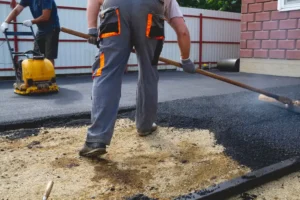
Cold mix asphalt is used for temporary repairs, especially in colder weather, because it does not require heating.
Compaction is the process of pressing asphalt or base materials to remove air and increase strength.
Concrete pavement is a rigid surface made from cement and aggregate. Concrete curbing is often used alongside asphalt.
Asphalt crack repair and crack sealing fills and protects cracks, preventing water damage and extending pavement life.
Crushed stone is a key material used in base layers and asphalt mixes for added strength.
Concrete curbing and gutter systems are installed to control water flow and protect pavement edges.
Dense-graded aggregate is a tightly packed mix of stone sizes that creates a strong, stable base layer with minimal empty space.
Drainage refers to how water is directed off pavement. Good drainage helps prevent pooling, cracks, and long-term damage.
Edge cracking occurs along the sides of the pavement, often due to inadequate support or poor drainage.
Expansion joints are gaps built into pavement or concrete to allow for movement during temperature changes and prevent cracking.
Fatigue cracking occurs after repeated traffic stress weakens the pavement over time. It often develops into alligator cracking.
Fog seal is a light coating applied to asphalt to protect the surface, reduce wear, and slow aging.
Full-depth reclamation is a process that rebuilds pavement by recycling existing materials and stabilizing the base, creating a strong foundation for new asphalt.
Geotextile fabric is a layer placed between soil and aggregate to improve stability and prevent mixing of materials.
Grading shapes the ground before paving to ensure proper slope and drainage, which is critical for long-lasting pavement.
Hot mix asphalt is the most common paving material, made by heating asphalt binder and aggregate before installation. It provides a smooth, durable surface used in most asphalt paving services.
Infrared asphalt repair uses heat to soften the existing pavement, allowing it to be blended and reworked seamlessly.
These are individual concrete units arranged in patterns to create decorative, durable paved surfaces.
Joint sealant is a flexible material used to fill gaps between pavement sections to keep out water and debris.
Lane joint cracks form between two paved lanes when the bond between them weakens.
A lift is a single layer of asphalt placed during construction. Multiple lifts are used to build strong pavement.
Parking lot striping & marking includes painted lines and symbols that guide traffic and organize parking lots.
Milling is the process of grinding down and removing the top layer of asphalt to prepare for resurfacing or repairs.
Mix design determines the right blend of aggregate and asphalt binder to create strong, long-lasting pavement.